Short answer
Start with the client: ask who they lose leads to and who customers mention. Check who ranks and who appears on the map for the client's main service and city. Keep 3 to 5 direct competitors, watch the pages that state prices, offers and services, and review the list every quarter.
Start with the client, not a tool
Your client already knows most of their competitors. They just have not written them down. Ask these at kickoff:
- Who did you lose a job or a lead to in the last few months?
- Which names do customers mention when they compare you?
- Who do you already keep an eye on, and why?
- Who is cheaper than you? Who is more expensive and still busy?
- Has anyone new opened nearby or started advertising hard?
The answers to the first two questions are the strongest signal you will get. A competitor that wins real deals matters more than one that ranks well.
Check the search results
Next, see who the client's customers see. Search the client's main service plus their city, as a customer would. Note who appears in the map results, who ranks on the first page and who runs ads. Repeat for two or three of the client's core services.
Names that show up across several searches, and also came up at kickoff, go on the shortlist.
Sort them into three groups
Direct competitors
Same service, same area, same kind of customer. These are the ones to track closely. Their price and offer changes affect your client's leads within weeks.
Indirect competitors
A different route to the same budget. A national chain, a franchise, or a cheaper alternative to the service. Check on them now and then, and mention them in the quarterly review.
Benchmarks
A business your client wants to look like. Useful for ideas, rarely for weekly reporting. Leave them off the tracked list unless the client asks.
How many to track
Three to five direct competitors per client is the sweet spot. Fewer, and you miss moves. More, and the updates turn into noise nobody reads. A small local client may only need three. A client in a crowded city market may need five.
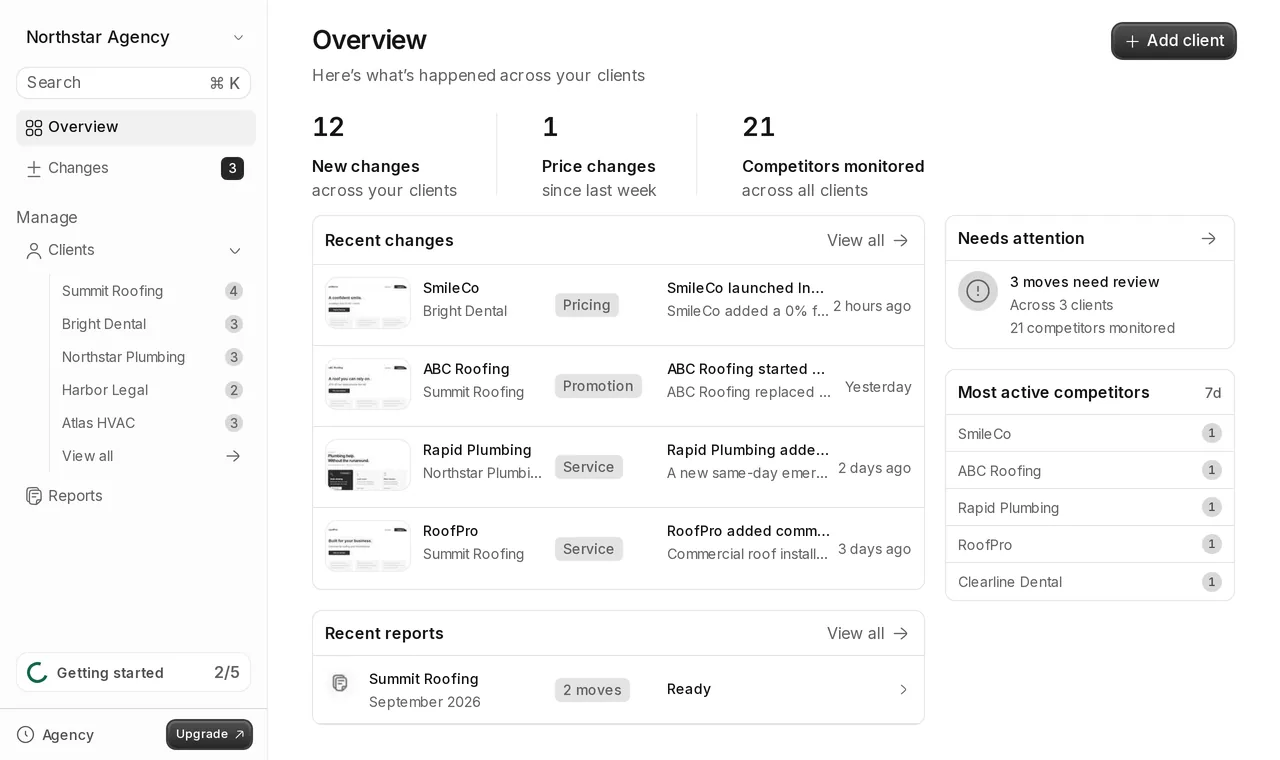
If you use Tonic, the competitor limit is shared across your whole roster, so you can give a busy client more and a quiet one fewer. See how client and competitor limits work on each plan.
Pick the pages to watch
For each competitor, a few pages carry almost all the signal:
- Pricing or rates. What they charge.
- Offers or specials. What they discount, and until when.
- Services. What they sell, and what they stopped selling.
- The homepage headline. How they want to be seen.
Tonic tracks up to 3 key pages per competitor and finds the pricing and offer pages for you, so you only enter the website.
Write down why each one is on the list
Give every tracked competitor a one-line reason: "wins on price on the north side", "same insurance-claim niche", "new in town, advertising hard". It takes a minute and pays off every month. When a change comes in, the reason tells you whether it matters to this client.
Review the list
Revisit the list every quarter, and sooner when the client launches a service, moves into a new area, or keeps losing leads to a name you do not track. Swap out a competitor that never changes anything and never comes up in sales conversations.
The kickoff checklist
- Ask the client who they lose leads to and who customers mention.
- Search the main service plus city. Note map results, top results and ads.
- Sort candidates into direct, indirect and benchmarks.
- Keep 3 to 5 direct competitors.
- Pick the pricing, offers and services pages for each.
- Write a one-line reason for each competitor.
- Save a dated baseline screenshot of every page.
- Put a quarterly review in the calendar.
Once the list is set, the next decision is how to watch it. Our guide to choosing a competitor monitoring tool for agency work compares the main types of tools honestly.